view counter

Regulars (Sky Watch by J. Alex Knoll)

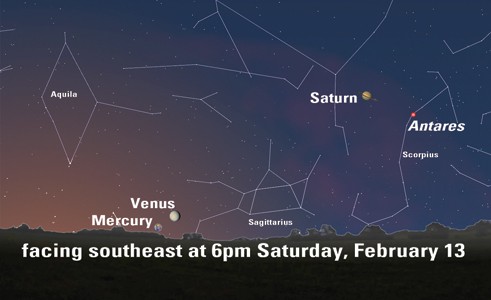
Saturn, Mars and Venus vie for position in the west at twilight

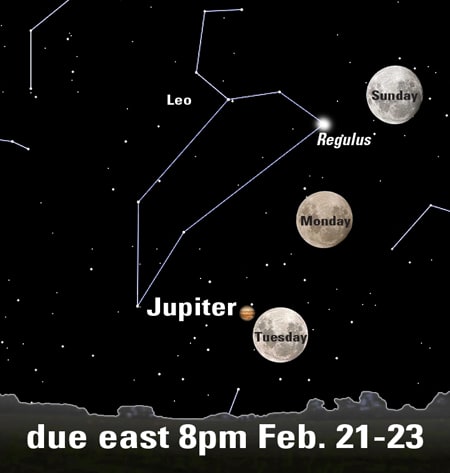
The waning moon rises after 10pm at week’s end, then crests the horizon 20-plus minutes later each night, so that by Tuesday, the last-quarter moon rises after midnight. Friday’s gibbous moon rises with glowing Jupiter only six degrees to the south, and the two remain tight through the wee hours before dawn, appearing high in the south with sunrise Saturday at 6:06. The sun sets this week around 8:15, and each day it leaves us more than a minute earlier. As the sky darkens, a bright...

Saturn, Mars and Venus vie for position in the west at twilight

  The waning moon rises after 10pm at week’s end, then crests the horizon 20-plus minutes later each night, so that by Tuesday, the last-quarter moon rises after midnight. Friday’s gibbous moon rises with glowing Jupiter only six degrees to the south, and the two remain tight through the wee hours before dawn, appearing high in the south with sunrise Saturday at 6:06.  The sun sets this week around 8:15, and each day it leaves us more than a minute earlier. As the sky...

July’s Thunder Moon deadens all but the brightest lights

  The gibbous moon waxes through southern skies this week, becoming full on the 25th. July’s full moon is known as the Hay Moon or the Thunder Moon. Rising at dusk and setting at dawn, the full moon dominates the sky this week, blotting out all but the brightest planets and stars. As the sun sets in the northwest before 8:25 this week, the first light to appear is the evening star Venus, 20 degrees above the western horizon. As dusk gives way to darkness, Venus is joined by ruddy...

This week, the west is best

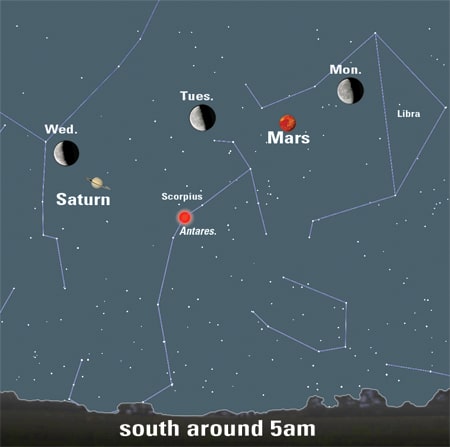
  The sun this week passes a psychological yardstick, setting at 8:30 Friday and then a little less than a minute earlier each night. The sun’s exit, stage right, is the parting of the night’s curtain, revealing a stage full of luminaries. The waxing moon reveals a shadow of itself even in the glare of twilight, high in the southwest at week’s end. Thursday it shines just a few degrees below Mars and 10 degrees to the right of golden Saturn. Venus, unmistakably brilliant...

The statues of Easter Island have front-row seats for solar eclipse

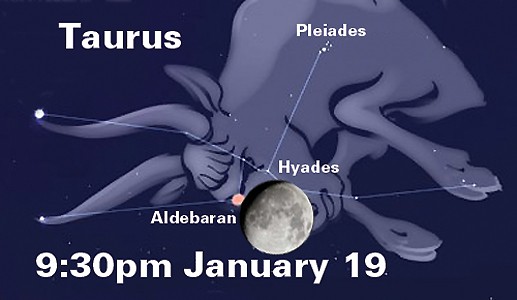
Early risers Friday might catch the last of the waning crescent moon low in the east in the 90 minutes before daybreak at 5:48. Ten degrees to its left, glows Aldebaran, the bright red heart of Taurus the bull. Later that same day, as darkness settles in after 8:30, Venus appears above the west horizon. The bluish light of Regulus shines about one degree to the lower left of Venus, but there is no comparison, as the so-called evening star shines more than 150 times brighter than the real star....

The statues of Easter Island have front-row seats for solar eclipse

  Early risers Friday might catch the last of the waning crescent moon low in the east in the 90 minutes before daybreak at 5:48. Ten degrees to its left, glows Aldebaran, the bright red heart of Taurus the bull.  Later that same day, as darkness settles in after 8:30, Venus appears above the west horizon. The bluish light of Regulus shines about one degree to the lower left of Venus, but there is no comparison, as the so-called evening star shines more than 150 times brighter than...

Looking at a star map, the world really is turned upside-down

A reader asked what she was seeing from her northeast-facing window. “Would I see evening or morning stars in this direction?” And would the same be true for planets? “I did look at your column and thought I understood the paragraph about Venus, but now I'm not so sure. Help! Thanks a bunch.” Only after reading and re-reading did I realize her problem: I was flat-out wrong, falling victim to my own sky map, inverting east and west, thus greatly confusing this reader...

Still plenty to see in nine hours

  The waxing moon reaches first-quarter phase Friday, appearing high in the southwest with sunset at 8:24. Each night after, the moon appears 15 degrees farther to the east and sets roughly 30 minutes later.  Thursday the moon shines less than 10 degrees to the right of Mars, well within the space of your fist held at arm’s length. A little beyond Mars shines Regulus, the heart of Leo the lion. While Mars is only a little brighter than its apparent stellar neighbor, the planet...

A lot of factors explain this puzzle

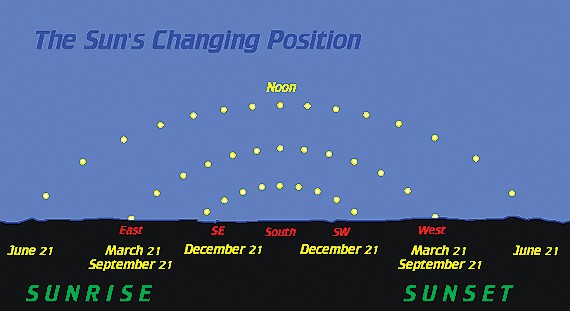
  Summer solstice is still more than a week away, but the sun rises its earliest of the year just before 5:40 Monday the 14th. While solstice is the longest day of the year, it marks neither the earliest sunrise nor the latest sunset, which falls a week after solstice. This is due to several interacting factors cumulatively called the Equation of Time. Earth spins on its 231x2-degree tilt of rotational axis, which causes the changing seasons. It also affects the time of day that the sun...

While binoculars help reveal distant stars and planets, our own galaxy is disappearing before our very eyes

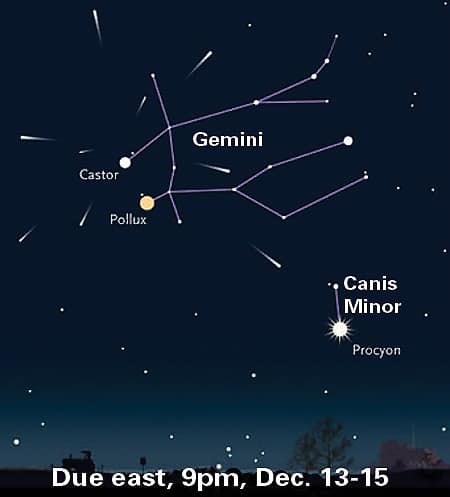
  As the sun sets around 8:30 this week, Venus appears in the west, the brightest object visible. Note the difference between Venus and the two first-magnitude stars Castor and Pollux a few degrees above and to the left. Venus sets in the northwest around 11pm, and pretty much sticks to this schedule throughout summer. Sunset also reveals our other neighbor, Mars, high in the southwest. Mars has been inching to the east, toward the blue star Regulus of Leo the lion. The evening of Sunday...
Syndicate content