view counter

Regulars (Sky Watch by J. Alex Knoll)

Five planets brighten these long nights

All the naked-eye planets decorate our night skies the next couple weeks, with the two brightest coming into view at sunset but all staggered throughout the dark hours.     The sun sets around 4:45 this week. By that time you’re likely to see Jupiter presiding over the eastern skies. Look to the opposite horizon where Venus blazes even brighter in the wake of the setting sun. Venus sets within two hours of the sun. Jupiter, on the other hand, shines through much of the...

Bright lights warm dark nights

We’re still a couple weeks from winter solstice, the day with the least sunlight for us in the Northern Hemisphere. But we’re already enjoying later sunsets one day to the next. Wednesday the 7th, old Sol sunk beneath Annapolis’s southwest horizon at 37 seconds past 4:43, the earliest sunset of the year. By the solstice December 21, the sun sets more than two and a-half minutes later at 4:47:03.     December’s full moon Saturday is called the Yule Moon,...

Ancient lava and endless impacts color our natural satellite

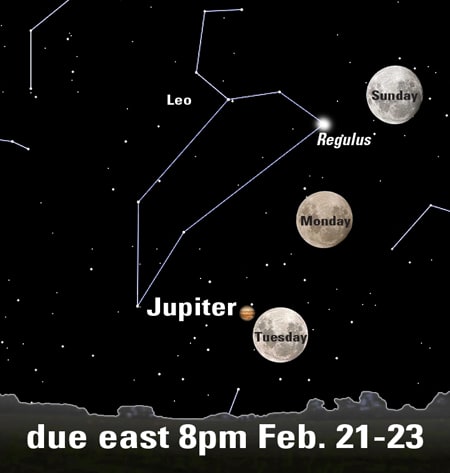
No doubt you’ve noticed the blazing light high in the east at sunset. The planet Jupiter rules over the rising stars of autumn and blazes until the wee hours before dawn. By 9pm it is a little to the south of the sky’s zenith; by 1am, Old Jove is high above the west horizon until finally setting in the northwest around 4am.     As if Jupiter didn’t stand out enough, it appears all the more prominent Monday and Tuesday, when it’s joined by the waxing...

Fill up on these heavenly views

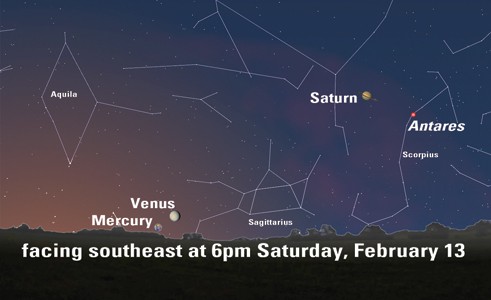
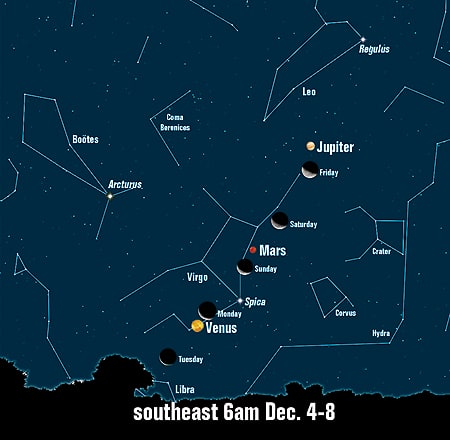
Friday’s new moon re-emerges as a razor-thin crescent with sunset Saturday, at 4:45. Look for it low in the southwest, its bottom tip pointing to dazzling Venus just a few degrees higher. Mercury lurks a little farther from the moon but closer to the horizon and buried so deep you’ll likely need binoculars to pick it out before it sets at 5:30.     Sunset Sunday reveals the waxing moon a little higher above the southwest horizon, now with its curved back to Venus,...

The moon dulls this year’s Leonid meteor shower

In the dark before dawn Friday, countless pieces of cosmic debris bombard the earth as it passes through the path left by comet Tempel-Tuttle. As these bits of ice and dust collide against the planet’s atmosphere, they burst aflame. While none of these threaten the planet, few of them will be visible against the light of the first-quarter moon, which coincides with the peak of this year’s Leonid meteor shower.     Under dark skies, the Leonids typically deliver 10 to...

Every so often, the planets align

This week is your last chance of the year to spot all five naked-eye planets, although it’s not easy pickings against the light of Thursday’s full moon.     As darkness settles, look for Venus and Mercury low in the west-southwest. Venus shines so bright you may spot her even with the glare of the setting sun. Not so with Mercury. While the innermost planet is only two degrees below Venus, it is so tight against the horizon that it is best located with binoculars, at...

While we’re seeing less of the sun, the nights are lighting up

The sun sets in the west-southwest just after 6:00 at week’s end and more than a minute earlier each day thereafter for the next couple weeks. It’s no better in the morning, with sunrise at 7:36 Friday but more than a minute later each following day. So while Sunday’s return to Standard Time may give us back the hour of morning sleep it stole from us last April, setting our clocks back that one hour cannot stave our actual loss of daylight.     But with...

You don’t need to wait until 2062

Who hasn’t heard of Halley’s Comet, that most famous celestial interloper that passes earth every 76 years? While we’re not due for another visit from the comet until 2062, we’re reminded of it each year around this time.     Week’s end marks the return of the annual Orionid meteor shower, the offspring of Halley’s Comet. Competing light from the waning crescent moon will dampen the shower’s pre-dawn peak Friday and Saturday. Even so,...

Start looking for Venus and Mars

The recent Hunter’s Moon still dominates the night sky when it rises after sunset Thursday, with the piercing light of Jupiter to the moon’s right. While the waning moon rises later through the week, Jupiter rises earlier until reaching opposition October 28. At that point, the gaseous giant will be directly opposite the sun, rising in our east at sunset, shining at the sky’s apex around midnight and setting in the west at sunrise. There should be no mistaking Jupiter, as it...

It’s a mess of a place up there

Like calendar pages strewn across an untidy desk, the stars of summer and even spring linger after sunset, with their autumn and winter counterparts commanding the heavens before dawn.     The sun sets before 6:40, with full darkness following little more than an hour later. Arcturus, the brightest early-evening star and fourth-brightest of all, appears in the sun’s wake due west. The main star of Boötes, the herdsman, Arcturus is the celestial spring sentinel. It sets...
Syndicate content