view counter

Regulars (Sky Watch by J. Alex Knoll)

Can you see the Milky Way?

A week after solstice, the 28th marks the latest sunset of the year, at 44 seconds past 8:35. And while a few bright lights will pierce the glare of twilight, it isn’t until nearly 10pm that the sky truly darkens and the stars start to shine.     Saturn is likely to be the first object you see, high in the southwest at sunset. High above it is the amber glow of Arcturus, the brightest star visible. Trailing 15 degrees behind Saturn is Spica, a bit dimmer and blue compared...

Hidden amid the year’s shortest night, the sky beckons

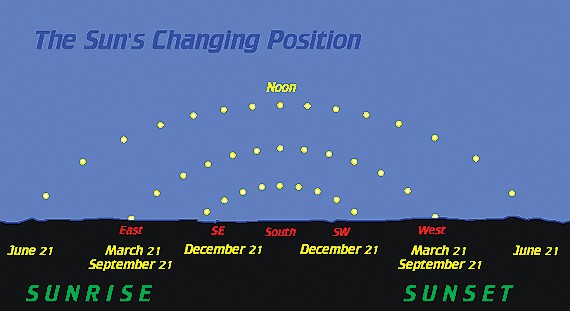
With days upon days of scorching weather already, you might be surprised that summer begins only this week, on June 21, with the summer solstice. On this day, the sun reaches its farthest point north in the sky, 231⁄2 degrees north of the equator directly over the Tropic of Cancer. That morning the sun rises at 5:40 and sets 14 hours, 55 minutes later at 8:35.     Although summer solstice does indeed provide us with the most daylight of the year, it is by no means the...

The full moon is at its lowest, while the sun nears its peak

Week’s end finds the waxing gibbous moon high in the south at sunset, around 8:30. Thursday evening it shines to the west of golden Saturn and the blue-white star Spica, but the next night it has snuggled within 10 degrees of both, forming a loose triangle. Saturn and Spica are currently about a dozen degrees apart, but keep an eye on them over the coming months as the ringed planet edges eastward for an autumnal conjunction.     By Monday the near-full moon appears low in...

Let the waxing crescent guide you through the heavens

As the sun sets near 8:30 Friday, look for an ever-so-slender crescent moon hugging the west-northwest horizon. Just two days past new phase, only about five percent of the lunar disk will be illuminated. To spot this sliver of moon, you’ll need an unobstructed view of the horizon, and binoculars may help you to pick it out from the lingering glare of dusk.     The next night, the waxing crescent moon is higher above the horizon at sunset, and now more than 10 percent of...

Look overhead to Corona Borealis

With week’s end, the sun sets at 8:20 and each night after almost a minute later. But it’s still more than an hour later that the glow of dusk gives way fully to darkness. By that time Saturn shines high in the south, the only planet visible until well before dawn.     Don’t confuse Saturn’s steady golden glow for the cool-blue twinkle of Spica, equally bright but 15 degrees to the southeast. High above the two is much brighter Arcturus, easily the...

Look for the hero Hercules between the stars of spring and summer

The waning gibbous moon rises in the southeast a couple hours before midnight at week’s end, but Tuesday’s last-quarter moon does not crest the horizon until almost 2am.     The sun this week sets around 8:15, revealing the three brightest spring constellations: Leo the lion, marked by aquamarine Regulus; Boötes the herdsman, punctuated by rose-hued Arcturus, the fourth brightest star in the heavens; and Virgo, goddess of fertility, marked by Spica, the shaft of...

Four planets await the keen-eyed early bird

The sun sets this week around 8:10. Following the trail of the sun, look above the northwest horizon for golden Capella, the sixth-brightest star. Opposite, in the northwest, shines Vega, the fifth brightest star. This time each year, the two line up at the same height in the sky, right now around 10pm.     Friday, the waxing moon shines 10 degrees below Saturn. The ringed planet appears high in the southeast at sunset. By midnight it hovers in the southwest before finally...

Meteors and planets dance across our skies

The annual Eta Aquarid meteors will likely be at their best before dawn Friday with encores possible early Saturday and Sunday. Unless you’re pulling an all-nighter, you’ll have to wake early, as the closer to dawn the greater their intensity.     The spawn of dust and debris from Halley’s Comet igniting against earth’s atmosphere, the Eta Aquarids are not the most furious meteor shower, producing from 10 to 40 meteors an hour. What they lack in numbers,...

Follow the Big Dipper

The sun sets a little before 8:00 this week, with full darkness coming almost an hour later. By that time, the great bear Ursa Major is almost directly overhead. The third-largest constellation, Ursa Major has been seen as a great she-bear by ancient peoples from Greece to India, Babylon to North America. In the modern age, when the few bears most of us see are captive in zoos or performing in circuses, we are more familiar with the seven stars of the bruin’s hind-quarters, a grouping...

Only the strongest of this year’s Lyrid meteors will pierce the glare

The waning gibbous moon rises around midnight at week’s end and shines bright through dawn, which puts a damper on the annual Lyrid meteor shower, peaking in the dark hours of Thursday/Friday and Friday/Saturday.     Even under ideal conditions with no competing moonlight, the Lyrids tend to max out at 15 to 20 meteors an hour. But any meteor bright enough to pierce the moonlight is likely to catch your attention as it streaks through the sky. Additionally, many of the...
Syndicate content