
|
 |
||||||||||||||||||||||||||||||||
|
|||||||||||||||||||||||||||||||||
The Girl Who Forgot Christmasby Helena Mann-Melnitchenko |
Editor’s note: Traditions return with the holidays, knitting our pasts and present into a garment we wear into the future. At Bay Weekly we’ve made it a holiday tradition to tell you a story of the season’s milestones in our extended family. In a year when America has seen the faces of its own refugees, we bring you the Christmas story of a refugee who became an American. |
In Search of Lost Time
On snowy winter evenings, we sat together at the communal table. After a supper of split peas and Spam, or, more often, soup and black bread, provided by the United Nations Relief Organization, the adults spoke of their old lives. My 15-year-old brother escaped to join his friends before the stories started, but I listened avidly.
They spoke with an incongruous air of formality, as if to hold off the enforced intimacy of the shared room. They addressed my father as Professor, observing the courtesies of the old country. My father, uncomfortable at being singled out, dismissed the others’ deference with a wave of his hand. “It’s all in the past now,” he said, pushing back his wire-rimmed glasses. His face, topped by graying hair, was lined, but his blue eyes were lively.
My mother’s strong face was smooth. A white streak of hair blazed from the top of her forehead and hid itself in the bun at the nape of her neck. Her dark eyes were remote, as if she were in some other place. I snuggled first in her lap, then in my father’s, finally crawling under the table to listen to their stories in the comforting dark. Often, they forgot my presence and said things that a child should not hear.
Each of the people in the room had their own story. As the days shortened and darkness came early, the man next to our cubicle spoke less and less. But one day, haltingly, taking deep breaths, he began:
“It was an ordinary day at the end of December. The ground was already frozen hard. The usual air raid around 10 in the morning. That evening we came home from work and saw,” he paused, took in great gulps of air as if his lungs would burst, “a hole in the ground where our house once stood. My sons, my sons …”
The Three Marias
As Christmas drew near, the two older couples on either side of the three Marias complained of whispers, murmurs and giggles coming from their cubicle, even after lights-out. Three girls in their teens, each called Maria, had been taken from their farms and families to work in wartime factories.
They were unlike in appearance and temperament and came from different parts of Ukraine. The oldest one — she must have been 18 — was tall and serious, with dark hair and eyes, her face scarred with acne. The chestnut-haired Maria, the prettiest one, had deep green eyes and spent most of her time with her nose in a book. The youngest and smallest was a blonde with large blue eyes in a round baby face. She was effervescent and frequently teased the other two, pulling them out of their occasional somber moods. Young themselves, they played games with me. I adored all three.
So it fell on me to find out their secret. It took a few nights of cajoling and whining, but the youngest could not hold their secret anymore. One of them was being courted by a young man. Romance had come to Room 18.
The week before Christmas, snow hid the ugliness of the camp. I intensified my efforts with the chains and snowflakes. “But where will we hang them?” I asked the three Marias. “We have no Christmas tree!”
“There’re pines in the forest,” the blonde Maria replied, giggling.
“Yeah,” I said. “And who’s gonna let us cut them down? Besides, we have no axe.”
“Don’t worry, little one. We’ll find a way.”
The Adventure
We were trudging home from school, when my father asked in a conspiratorial tone: “Do you want to go on an adventure?”
I jumped up and down. “When, where?”
“Tomorrow is Christmas Eve. In the morning we’ll take the trolley outside the gate to the city.”
Excited, I pranced about in the snow. “What will we do there?”
“Buy your mother a present.”
I clapped my hands; then my heart sank. “But we need money.”
“Of course,” he said and pulled out some bills. “They pay me a little for teaching school.”
I could not sleep at all that night.
Next day, the sky was pewter with the threat of snow. Bundled up in almost everything we owned, we started out for the station, ignoring my mother’s entreaties to stay in the camp.
My father held my hand as we made our way across the fields covered with frost. The trolley station — the end of the line — provided little shelter from the biting wind. We waited in the cold for what seemed an eternity. Finally the trolley came. It was empty.
After several stops, the fields gave way to suburbs. Others boarded, including a young man on crutches, a boy really. The insignia on his long military coat were nowhere to be seen, but I realized he was a former soldier. I stared at him with wide eyes. One of his legs was missing. When our eyes met, we both looked away.
We got off in the center of the city. Narrow cobblestone streets led off the square. I felt small and insignificant. The buildings seemed huge, the church dazzling. People rushed about. We wandered, gazing into the store windows displaying few wares.
“What shall we get her?” I asked. One store displayed somber dresses, another shoes. “She has shoes and a dress prettier than these.”
My father seemed undecided, crestfallen by the prices in the windows.
“Let’s walk some more. We’ll find something.”
In the side streets, the display windows were smaller. Fewer people bustled about, casting wary glances at our shabby clothes. We walked uphill from the square and came upon a leather goods shop. And there it was: a bittersweet chocolate brown purse with a brass clasp. “This is it,” I told my father. “This will be beautiful with the shoes and the dress.”
The little bell tinkled, and the shopkeeper looked up from the newspaper he was reading. In his broken German, my father asked to see the purse. The shopkeeper seemed dubious, but then with an amused what-the-heck expression, brought the purse out. He pointed to the price. My father considered as I touched the leather, soft as butter. My eyes, raised to my father’s face, were pleading. The shopkeeper waited with folded arms.
“Ya, we’ll take it,” my father said finally as he brought out the bills from his coat pocket. He pointed to the tissue paper behind the counter. The shopkeeper understood. Feeling powerful, I laughed as we left the shop with our prize.
 |
|
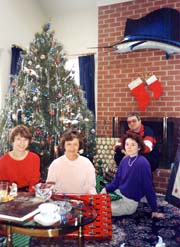
The writer, center, at home for Christmas with her daughters and husband Gene in the background. |
“One more stop,” my father said, as he steered me to the bakery on the corner. Margarine, spices and vanilla enveloped us in a warm embrace. “Bitte, fix us two boxes of those and those,” my father said, pointing to the display.
“You must have a large family,” the girl, a crown of golden braids on her head, said as she filled the boxes.
“We do. There are 13 of us,” my father said smiling.
Dusk was falling as we caught the trolley back to Karlsfeld Displaced Persons Camp. It was dark when we disembarked. The threat of snow had not materialized. The sky was full of stars. “There’s the star of Bethlehem,” my father pointed to the brightest one. It had turned very cold, and snow crunched under our feet as we trudged home.
A Safe Haven
The door opened and I gasped as I saw my mother standing silhouetted in the yellow light. She wore the black dress, the chocolate brown shoes and two unmatched earrings. I didn’t remember her ever looking that stately and elegant. “We were so worried,” she scolded, relief in her voice, as she hugged us.
Over her shoulder, I spied a raggedy Christmas tree, resplendent in white paper chains and snowflakes, standing on the middle of the table. I was mesmerized. There was Christmas after all.
When I could finally tear my eyes from the tree, I noticed the bread, dark as night, and sausages, fat as doves, arranged on iron plates on the table. A citrus scent wafted from a box of tangerines.
A handsome young man, not many years older than my brother, stood proudly by the table with his arm around one of the Marias. She was blushing and shyly playing with her chestnut hair. The secret romance was not a secret anymore.
I walked over to the tree and touched the spikiness of its needles and breathed in its piney scent. Could it be? A safe and happy place stirred in my memory.
“Where did you get it? How?”
Laughter, pride and mischief in his eyes, my brother told the story of how he, the three Marias and the young man snuck out to the forest at dusk and cut down the tree.
“But how? What did you use to cut it down?” my father asked.
“Simple. I borrowed some tools from the shoemaker down the hall,” my brother answered.
The adults showed restraint, but the young people gasped with delight when my father opened the cookie boxes. I reached for a golden sugar cookie. Its sweet rich taste nudged my lost memory further.
Eagerly, we opened the few presents. I trembled as I unwrapped mine: a notebook and six colored pencils. Immediately, I started drawing: a boxy house with smoke coming out of the chimney, a Christmas tree in one of the windows and a cat sitting on the doorstep.
“This is for everything that happened,” my father said to my mother as he handed her the present. She unwrapped the white tissue slowly and caressed the soft leather. Something passed between them, something I could not read.
Suddenly, we heard commotion in the hall. “Oh, no!” My heart leaped to my throat. “They’ve come to arrest the young people — my brother — for cutting down the tree.”
The American soldiers tromped in, joy on their faces, and as they sang my father translated: “Peace on Earth, good will to men, Christ is born in Bethlehem.”
 |
|
About the Author |