
|
Volume 16, Issue 45 - November 6 - November 12, 2008
|
|
Columns |
 |
Sky Watch by J. Alex Knoll
Night Lights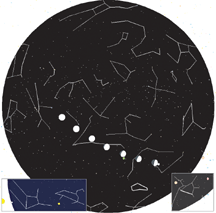
Fleeting planets and winter’s coming constellations
Venus and Jupiter hover above the southwest horizon at dusk. For the next month, watch these two pull together by about one degree each night, culminating in a spectacular conjunction, at month’s end. Although mired in the residual glow of sunset above the southwest horizon, Venus, at magnitude –4, is more than twice as bright as Jupiter. While the gaseous giant sinks toward the skyline, Venus climbs a little higher night by night.
After Venus and Jupiter set, at 7pm and 9pm, the sky is empty of planets until golden Saturn rises in the east at 2am. Don’t be fooled by the dimmer white light of Regulus, the heart of Leo the lion, 20 degrees ahead of the ringed planet. Trailing Saturn by 30 degrees and rising a little before 5am is the blue-white star Spica of the constellation Virgo.
As the sky lightens with the approach of the morning sun, tiny Mercury crests the east-southeast horizon. This fleet planet is at the tail end of its best morning apparition of the year, and it dips lower in pre-dawn skies each day before disappearing amid the glare of the sun by mid-month. Even so, Mercury is the brightest object visible, shining steady a half-hour before sunrise.
Despite the added hour of morning light with last week’s return to Standard Time, the sun is running fast. At week’s end Friday, old Sol rises at 6:40 and sets a couple minutes before 5pm. But each day, it rises nearly a minute later and sets almost a minute earlier each evening.
The long, dark skies welcome the constellations of winter, with hourglass-shaped Orion leading the way. At the mighty hunter’s foot shines the bright star Rigel, juxtaposed by the red-giant Betelgeuse marking his shoulder.