
|
Volume XVII, Issue 2 - January 8 - January 14, 2009
|
|
Columns |
 |
Sky Watch by J. Alex Knoll
The Dance of the Sun and Moon
Without stepping on one another’s toes, they follow the same path
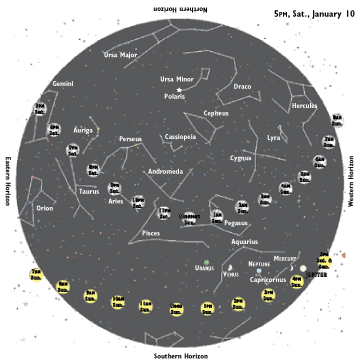
As the sun sets in the southwest around 5:00 Saturday, the full moon rises, juxtaposed in the northeast. This cold winter moon dominates the night in its steepest arch of the year. At midnight this moon reaches its apex directly overhead and then begins a slow descent westward before setting in the northwest almost 15 hours after first rising.
Just as the full moon sets Sunday morning, the sun rises in the southeast. Now a few weeks past solstice, our days grow a little longer each day, but the sun still travels along its lowest point in the southern sky, warming us with less than 10 hours of daylight.
Note where both the sun and moon rise and the set — roughly 231⁄2 degrees from due east and west. Once again, it’s earth’s 231⁄2-degree tilted axis at work.
January 5 marked our latest sunrise, at which point the sun rose 231⁄2 degrees south of due east. As a result of earth’s egg-shaped elliptical orbit, our earliest sunset came back in mid-December, when the sun sank beneath the horizon at a point 231⁄2 degrees south of due east. On solstice, the aggregate of the two, the noontime sun hovered a only 231⁄2 degrees above due south.
Over the next 10 weeks, the arch of the sun’s daily progress will inch northward. Then, on vernal equinox, the sun will rise due east and set due west.
Six months from now, in the early days of summer, the sun will rise in the northeast, where the moon rises now, nearly 231⁄2 degrees north of due east. It will peak directly overhead at noon and set nearly 231⁄2 degrees north of due west more than 14 hours after first light. The summer moon, meanwhile, will arch lazily through the southern skies.
Illustration: © Copyright 1925 M.C. Escher/Cordon Art-Baarn-Holland; Graphics: © Copyright 2009 Pacific Publishers. Reprinted by permission from the Tidelog graphic almanac. Bound copies of the annual Tidelog for Chesapeake Bay are $14.95 ppd. from Pacific Publishers, Box 480, Bolinas, CA 94924. Phone 415-868-2909. Weather affects tides. This information is believed to be reliable but no guarantee of accuracy is made by Bay Weekly or Pacific Publishers. The actual layout of Tidelog differs from that used in Bay Weekly. Tidelog graphics are repositioned to reflect Bay Weekly’s distribution cycle.Tides are based on National Oceanic and Atmospheric Administration and are positioned to coincide with high and low tides of Tidelog.
 © COPYRIGHT 2009 by New Bay Enterprises, Inc. All rights reserved.